Most tire advice online is written about pavement. A nail, a screw, a slow leak you can chase down with a spray bottle in the driveway. Real problem, clean fix. But a lot of the miles around Decatur are not pavement at all. They are caliche lease roads, gravel county roads, washboard two-tracks out to a pump jack, and cattle guards you cross four times a day in hay season. That surface does something different to a tire. It rarely pokes a hole in it. It hits it, cuts it, and wears its cords out, and the tire often keeps holding air like nothing happened.
That is what catches people out. The tire feels fine, the pressure reads fine, and then three weeks later there is a soft lump on the sidewall, or it lets go at 70 on US-287 with a trailer behind it. So here is what gravel road tire damage really looks like, why most of it only turns up with the tire off the wheel, and how to describe what you hit so the inspection gets done. It is one of the most common reasons a work truck needs tire repair in Decatur, TX.
Why Wise County Roads Are Hard on Tires in a Specific Way
Caliche is not gravel in the ordinary sense. Geologists describe it as a shallow layer of soil or sediment whose particles have been cemented together by mineral matter, and where it is firmly bound it can be very hard, dense, and durable. It is a familiar deposit across Texas, and it gets crushed and used as fill and aggregate because it is right there and works. Good for a road builder. Not so good for a tire, because the loose rock on top is hard and angular and will not politely crumble under a loaded truck.
Wise County has a lot of that surface for a reason. It is one of the four core Barnett Shale counties the Railroad Commission of Texas names, and it is where the first commercial Barnett well was drilled in 1981. Layer decades of that on ranch and farm traffic, and trucks out of Decatur, Bridgeport, Alvord, Chico, Boyd, and Rhome spend part of every week on roads built for equipment. Same duty cycle that gives a Wise County work truck’s diesel its own problems.
What that does to a tire:
- Loose angular rock that can slice the outer shoulder as the tire rolls and flexes over it
- Washboard that shakes the whole assembly and works a low tire hard
- Ruts and edges that pinch a sidewall between an obstacle and the rim flange
- Cattle guards, where a steel edge meets a dropping, loaded tire at whatever speed you took it
None of those is a puncture. All of them can end a tire, and none has to show up as a leak.
A Tire That Still Holds Air Can Still Be Finished
Air pressure is not a health check. All it tells you is that the tire is sealed right now.
The U.S. Tire Manufacturers Association is blunt about it. Not all tire damage that can lead to failure is outwardly visible, and innerliner damage can only be seen with the tire off the wheel. The Tire Industry Association says the same from the technician’s side: the tire has to come off the rim so the inside can be inspected, because something as ordinary as a nail in the tread can cause severe sidewall damage that never shows outside. If a nail hides that much, so can a rock strike with a loaded bed.
The industry lists conditions that should keep a tire out of service, and most are not leaks:
- Any indication of internal separation, such as bulges or patches of irregular or fast treadwear
- Any damage or wear exposing the body material of the tire: cuts, cracks, scrapes, impact damage, splits, snags
- Any innerliner or bead damage, or signs the tire has been run flat, underinflated, or overloaded
A tire can tick one of those boxes on Tuesday and still hold pressure all week.
Four Kinds of Gravel Road Tire Damage
1. Shoulder cuts and rock strikes
The outer shoulder is where the tread stops and the sidewall starts, and it is the part that catches rock on a crowned or rutted road. What you see afterward is a cut, a gouge, or a scrape near the edge of the tread. What you cannot see is how deep it went, or whether it reached the belt edge underneath. A hard hit can knock the suspension out of spec too, which is why a wheel alignment check often belongs in the same visit.
2. Impact damage that surfaces later as a bulge
This is the one that shocks people, because the tire drives normally for weeks first. The strike happens, the outside looks survivable, and then a bulge shows up in the sidewall. USTMA treats a bulge as an indication of internal separation and a reason to take the tire out of service. The lump is only the symptom. The injury happened when you hit the rock.
3. Run-low damage from washboard and slow leaks
Driving on a badly underinflated tire, even a short way, is its own kind of harm. USTMA publishes a photograph of exactly that: a tire driven a short distance while severely underinflated, left in a dangerous, non-repairable condition, with a note that the damage was not visible from the outside. A technician looks for innerliner abrasion, abrasion in the mid to upper sidewall, delamination, rim groove impressions, and cracking in the lower sidewall.
4. Cord fatigue nobody can detect
USTMA’s strongest warning is about this one. Permanent damage from underinflation or overloading cannot always be detected. Ply cords weakened that way can break one after another until the upper sidewall ruptures, which the trade calls a zipper, with instant air loss and explosive force. That is not a flat, that is a tire coming apart. Which is why “I only ran it low for a mile” is worth saying at the counter.
Your dash light will not save you here either. Tire pressure monitoring systems only have to warn the driver at 25 percent or more below placard pressure, so a tire can be well down and taking a beating on washboard before the light comes on. NHTSA found tires underinflated by 25 percent or more are three times as likely to be cited as critical events in the moments before a crash, and that about 26 percent of tires worn to 2/32 inch or less were on vehicles with tire problems, against about 8 percent at 3/32 to 4/32 inch.
Why Tire Sidewall Damage Usually Cannot Be Repaired
One rule governs almost every conversation about tire sidewall damage, and it surprises people who assume anything can be patched. Repairs are limited to the tread area, and the repairable injury is capped at 1/4 inch, about 6mm. The part that matters most on unpaved roads: USTMA says do not repair where the injury reaches into the shoulder or belt edge, or where it runs at an angle into the shoulder. If there is any question it reaches that far, the tire has to be scrapped, and the sidewall is never repairable at all.
A few other limits come up in real jobs:
- Repair units cannot overlap, so a tire with several old repairs may be out of room
- A puncture angled more than 25 degrees requires a two-piece stem-and-patch repair
- A tire damaged by underinflation or overloading, or carrying an improper old repair, must be scrapped
- A tire worn to 2/32 inch of tread depth anywhere is worn out regardless
That is why a shoulder strike so often ends in replacement rather than a flat tire repair. It is not caution for its own sake: the injury sits outside the zone the tire manufacturers say can be repaired. When replacement is the honest answer, we would rather show you the tire on the spreader, talk through the tire and wheel options that suit the roads you actually drive, and let you request a current quote knowing exactly why.
Why a Lease-Road Plug Is a Temporary Measure at Best
Everybody who works outside town has done it or watched it done. Reamer, string plug, cement, back to work. It gets you home, and there is a place for that. It is not a repair, though, and the industry says so in writing. TIA says on-the-wheel repairs like string plugs are not recommended and must be considered temporary, and that a plug alone, or a patch alone, is not acceptable, because the plug never permanently seals the innerliner. USTMA agrees: the injury has to be completely filled with suitable vulcanizing material or a rubber stem, and a patch has to go on the innerliner to stop air loss. They also say never repair a tire without taking it off the rim for internal inspection. Sealants land in the same bucket. So a plug put in on the shoulder of a lease road has two problems: nobody saw the inside of the tire, and it may be sitting where no repair is allowed at all.
What the Tech Sees Once the Tire Comes Off the Wheel
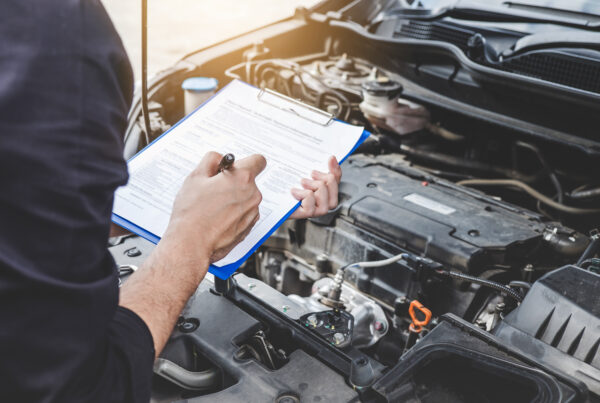
A proper inspection is not a glance. Following USTMA’s procedure, the tire, wheel, and valve get checked with soap solution to find the real source of the leak, the injured area is marked, and the tire comes off carefully so nothing new gets damaged in the bead area. Then it goes on a spreader, inspected inside and out under bright light.
Next the injury itself. The beads are spread, the puncturing object comes out with the angle of penetration noted, and the injury is probed with a blunt awl to see how far it goes and in which direction, checking for splits in the plies. All damaged material has to come out, and anything else found is part of the verdict. That is where a tire that still holds air turns into a different story.
How to Describe a Rock Strike So the Inspection Gets Done
Two people can walk into the same shop with the same tire and get different service, purely because of what they said at the counter. “It is losing a little air” describes a leak, and sends a shop looking for a puncture in the tread. “I hit a rock hard on the lease road Tuesday, driver’s side rear, doing about 40, and I ran it a mile before I checked it” describes an impact. That gets the tire off the wheel and inspected inside, where impact damage lives.
Bring these details with you:
- What you hit: rock, cattle guard edge, culvert lip, rut
- Where on the vehicle, how fast, and how loaded you were
- Whether it lost air, and how far you drove afterward on a soft tire
- Anything new since: vibration, a pull, a thumping noise, a visible lump
That is the difference between a tire getting looked at and one getting inspected.
Keeping Tires Alive on Wise County Caliche and Lease Roads
You are not going to stop driving those roads, so keep the small stuff from turning structural.
- Set pressure for the load you actually carry, and check it cold with a gauge rather than waiting on the dash light
- Slow down for cattle guards and washboard. Speed turns a rock into an impact break
- Never keep driving on a tire you know is low, and look at the shoulders and sidewalls when you fuel up, not just the tread
- Watch the wear pattern. Odd or fast wear in one spot can mean separation, and it can also mean uneven tire wear from something else, including alignment
- Put ranch and oilfield vehicles on a regular inspection schedule instead of waiting for a failure, which is what fleet service is for
Get It Looked At Before the Next Long Run
If you took a hard hit on a caliche road, if a plug got pushed in out on a lease, if you have a bulge you have been watching, or if you ran a tire low to get home, bring it to us in Decatur before the next highway trip. We will pull the tire off the wheel, show you what is going on inside, and tell you honestly whether it can be repaired to industry standards or needs replacing.
For flat tire repair in Wise County, tire repair in Decatur, TX, or a second opinion on a tire somebody already plugged out on a lease, we look after drivers and work fleets from Bridgeport and Alvord to Boyd, Rhome, and Chico.
Request a quote for tire repair or replacement and we will get you a current price, plus a straight answer on the tire in front of us.